New open robot model outscores Nvidia's, according to its developer
Black Forest Labs has released FLUX 3 Action, a robot model with open weights. The company says it beats Nvidia's Cosmos 3 Nano on a benchmark, but the figures have not been confirmed by a public leaderboard.
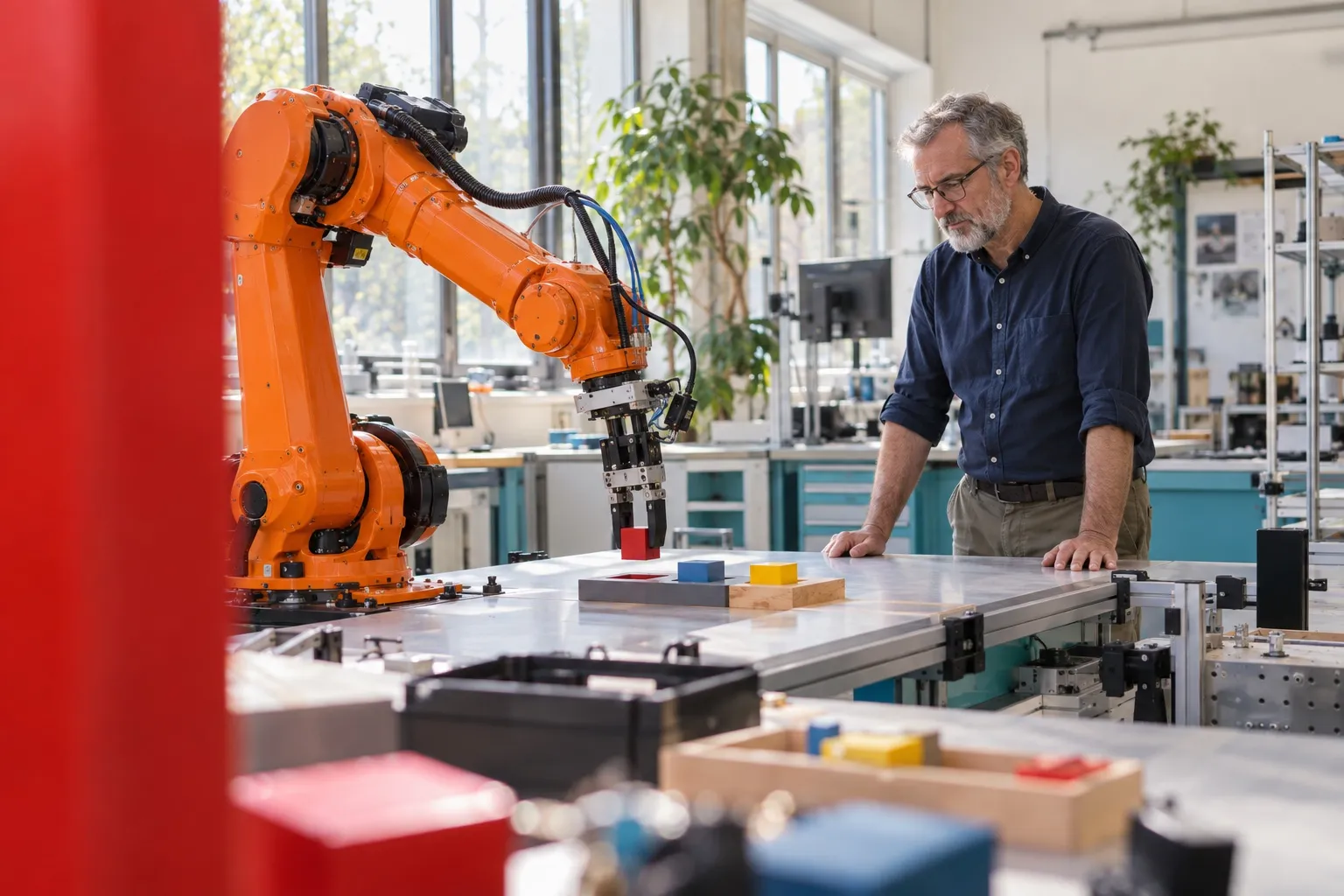
German AI company Black Forest Labs has released FLUX 3 Action, a model for controlling robots. It is a so-called World Action Model with 7 billion parameters. Parameters are the settings an AI model learns during training, and they are often used as a measure of a model's size.
The model takes in camera images, the robot's state and text instructions. At the same time, it predicts how the scene will look and what the robot should do. According to VentureBeat, it outputs the next 32 actions along with predictions of the scene.
Figures from the company itself
On the RoboLab-120 benchmark, the base model achieved a success rate of 42.92 percent, according to Black Forest Labs. Nvidia's Cosmos 3 Nano, which has 16 billion parameters, scored 36.8 percent according to the company's own table. VentureBeat writes that FLUX 3 Action is 3.9 percentage points ahead of the previous leading model, OASIS WAM, which scored 39.0 percent, and that it does so with less than half the parameters.
The figures are the company's own. VentureBeat writes that Nvidia's public leaderboard had not yet been updated when the article was published. The outlet also says the results are selected demonstrations and no guarantee that the model performs equally well elsewhere. Comparisons are difficult because robot models are tested in different ways.
On speed, the company says the model is 1.52 to 3.95 times faster than Cosmos 3 Nano. VentureBeat cites 1.43 times faster than Cosmos3-Nano-Policy. On an Nvidia B200 chip, latency is between 32.29 and 41.06 milliseconds, and the model can predict 2.13 seconds of motion per call.
Smaller, distilled variants are faster but score lower: 42.24 percent and 37.92 percent.
Open, but not entirely free
The model's weights, meaning the fully trained data that makes it usable, have been made openly available on Hugging Face and GitHub. There are both non-commercial and commercial licensing options. Commercial use does require a license, however, and pricing has not been announced. There is also no commercial API yet, and the model is being rolled out through select research and business partners.
The release includes code, fine-tuning recipes and examples. The model is compatible with Hugging Face's LeRobot, and one recipe has been tested on the SO-101 robot arm.
According to the company's page, Positronic Robotics, as an independent third party, tested the model on a Franka robot arm. It completed 28 of 30 attempts across ten tasks. The model has also been shown controlling a drone and playing Doom, but VentureBeat describes these as early experiments and not production-ready capabilities.
Updated 14 October 2026: The article has been rewritten from additional sources.
Read also


