ChatGPT text in the EU gets an invisible watermark in its word choice
In the coming weeks, OpenAI will begin marking text from ChatGPT and Codex in the EU with a statistical watermark. The detector is not open to ordinary users, and the mark can weaken if the text is edited.
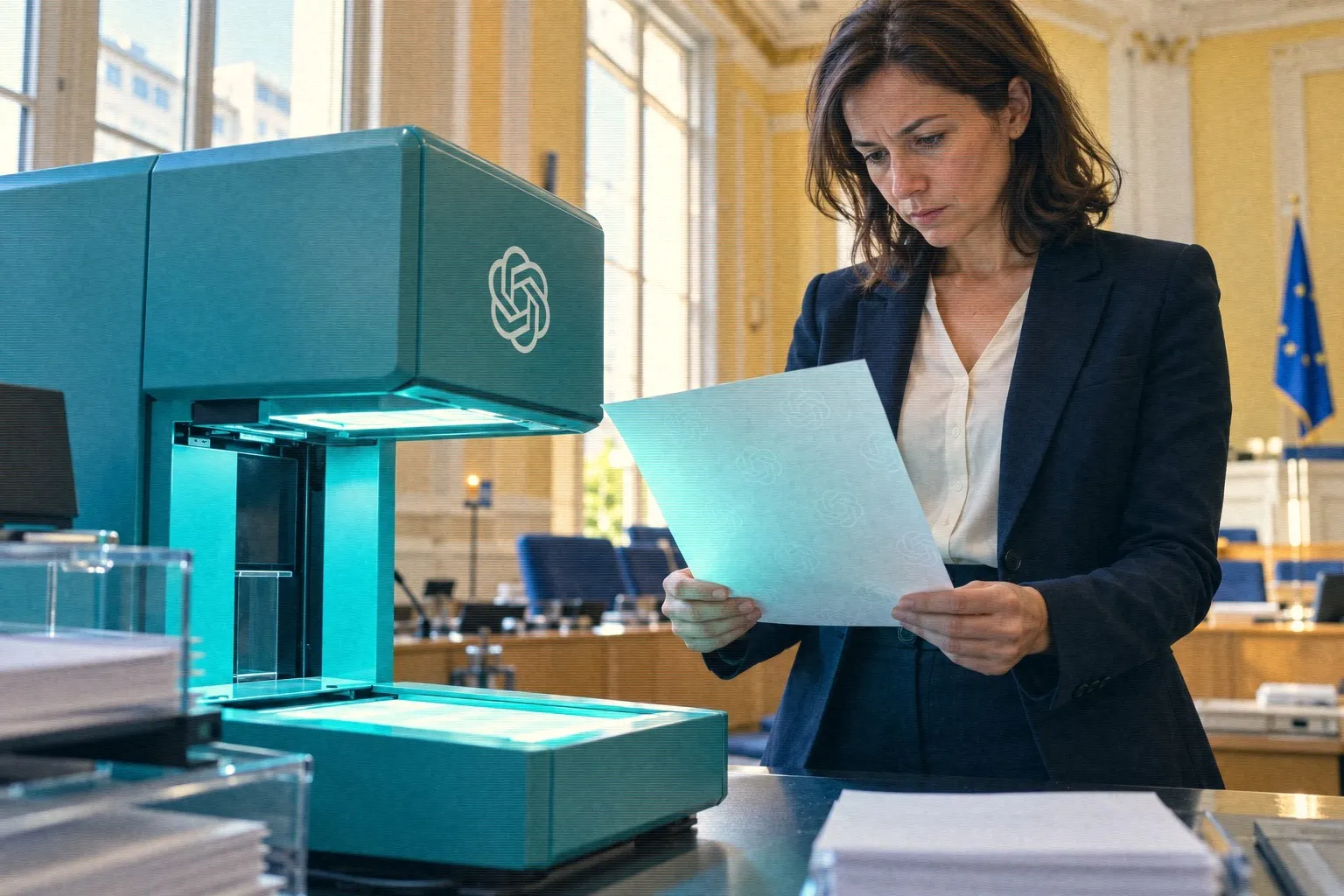
OpenAI has announced that in the coming weeks it will begin embedding an invisible watermark in text from ChatGPT and the coding tool Codex in the EU. Users don't need to do anything. The marking applies to eligible users on all subscription tiers. It is not clear exactly how "eligible" is defined.
A pattern in the word choice
The technology is called textGrain. No hidden characters are inserted into the text. Instead, the model builds a statistical signal into the words it chooses, and a detector can test whether the signal is present.
The background is the EU's AI Act, whose transparency rules apply from August 2, 2026. The rules require AI-generated text to carry a machine-readable marking so it can be recognized as AI-generated. According to a report in Itdaily, violations can result in fines of up to 15 million euros or 3 percent of global annual revenue.
Text from ChatGPT and Codex outside the EU will not be marked by default, Gizmodo writes. However, API customers worldwide can turn on text marking themselves for selected models as of the announcement. The feature is off by default.
What the watermark can and cannot do
The watermark can show that an OpenAI system generated or processed the text. It cannot show who used the system, how much a human contributed, who owns the text, or whether the content is accurate. OpenAI also says that a missing watermark does not prove the text was written by a human.
The mark is unreliable on short and edited texts. According to OpenAI's own tests, the detector found roughly 80 percent of 200-token texts about psychology and roughly 95 percent of 400-token texts. A token is a chunk of text, often a word or part of a word. When 10 percent of the words in a 400-token text were swapped for synonyms, the detection rate fell from about 92 percent to about 66 percent. At 25 percent replacement, it fell to about 17 percent. The figures come from OpenAI itself, as reported by Itdaily.
The detector is not open
OpenAI has not made the detector publicly available because of the risk of false positives, meaning human-written text being wrongly flagged as AI text. Access is granted case by case, initially to approved researchers and expert organizations. Itdaily writes that the detector will eventually become open source, but it is unclear when or whether that will happen.
Users in OpenAI's developer forum have pointed to concerns about consequences for people with dyslexia, the risk of misuse for discrimination, and the possibility of getting around the watermark by rewriting the text with open-source models.
Gizmodo writes that Anthropic launched similar marking in August, and that Google DeepMind has been marking output for years. According to Gizmodo, OpenAI does not require watermarks for users in the US, where there is no federal regulation.
Updated 12 October 2026: The article has been rewritten from additional sources.
Read also


