

Breakthroughs and research·September 19, 2026, 12:00
OpenAI claims AI has solved million-dollar math problem
AI-generated and checked against the sources listed below.
OpenAI says thousands of AI agents have solved one of the world's hardest math problems in under four days. But the victory is overshadowed by a dispute over credit and sharp criticism from mathematicians.
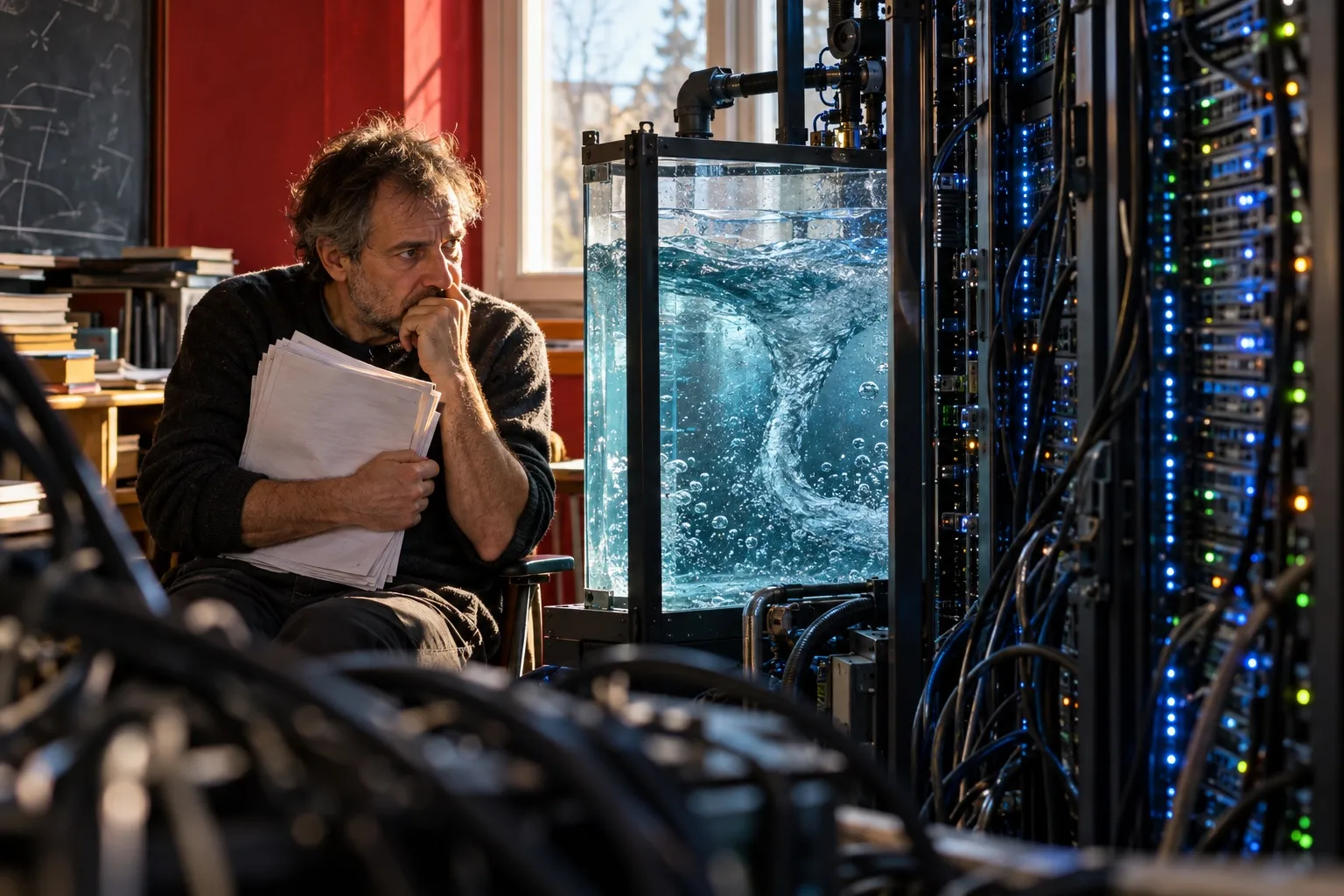
On September 8, the tech company OpenAI said that one of its unreleased artificial intelligences had found the answer to one of mathematics' seven so-called Millennium Prize Problems. These are problems for which the Clay Mathematics Institute once offered a bounty of one million dollars each.
The specific problem is called the Navier-Stokes problem and deals with how water and air move. The question is whether the equations for how a fluid flows in three dimensions always give a neat and predictable answer, or whether the velocity can in theory become infinitely large. According to OpenAI, its AI found a case where exactly that happens, driven by a vortex spinning inward. According to OpenAI, the insight can be used to understand violent turbulence, which engineers otherwise try to avoid in their calculations.
10,000 AI agents behind the proof
The solution was found by around 10,000 AI agents, meaning computer programs that can work on a task independently, which together spent about 88 hours on the proof itself. According to OpenAI, the whole effort cost around $22.5 million in computing power. The Clay Institute has not yet approved the proof and still considers the problem unsolved while it is being reviewed. OpenAI says it does not want the million-dollar prize.
Dispute over credit
The case quickly turned into a dispute over who deserves the credit. The mathematician Tristan Buckmaster of NYU and a researcher from rival Anthropic had for months been working on a similar version of the problem and published their results shortly before OpenAI. Buckmaster claims that OpenAI learned of their unpublished progress and only then set its AI agents on exactly that problem. He also says an OpenAI researcher urged him to remove his co-author's name from the credits. The researcher has since apologized for that remark, but maintains that he was trying to ensure both mathematicians received full recognition. OpenAI denies that either its researchers or its AI saw the other team's work before it was published.
Mathematicians warn of "slop mathematics"
The case has led 771 mathematicians to sign an open letter calling this kind of AI-generated research "slop mathematics," meaning hastily produced material that others are left to verify. OpenAI then withdrew a donation of one million dollars to a math competition for students. The next day, 25 winners of mathematics' most prestigious prize, the Fields Medal, warned that a race to solve famous problems could harm the field if the focus shifts from understanding to merely arriving at an answer.
For ordinary Danes who use AI at work, the case shows two things: AI programs working in large numbers can solve problems that used to take humans decades, but such breakthroughs still require independent verification and a critical eye before you take the companies' own claims at face value.
Sources



Get the week's AI news in your inbox
Choose your level, topics and length. One email a week, unsubscribe at any time.
Subscribe to Promptly Newsletter